

Benchmarks
What the latest run measured
80 synthetic test pages: 10 registry forms, each in 8 page qualities. Run on the live system on 17 October 2026, one run. Synthetic test forms only, latest run.
Headline figures
Counts, not promises
Every figure is a count of fields from this one run, 1,272 fields in all. Where a percentage is shown, it sits beside the count.
Read correctly
1,228 of 1,272
96.5% of all fields were read correctly, across all 8 page qualities.
Wrong value kept
1
1 of 1,272 fields, about 1 in 1,000. Every other doubtful field was handed to a person instead.
Sent to a person
43
3.4% of all fields went to a reviewer, each with the image crop of the exact spot on the page.
Fields missed
0
No field was skipped without a decision: each was read, or handed to a person.
Image crop in the right place
1,271 of 1,272
The reviewer sees the right part of the page, on photographed pages too.
By page quality
From clean print to a bent, photographed page
Each of the 159 fields per quality comes from the same ten forms, printed or captured in a different way.
| Page quality | Correct of 159 | Wrong value kept |
|---|---|---|
| Clean print | 156 of 159 | 0 |
| Light print | 155 of 159 | 0 |
| Office scan | 147 of 159 | 1 |
| Fax | 151 of 159 | 0 |
| Bent in the feeder | 155 of 159 | 0 |
| Bent at the spine | 155 of 159 | 0 |
| Photographed by hand | 155 of 159 | 0 |
| Flatbed with curl | 154 of 159 | 0 |
Counts from one run of synthetic test forms. A wrong value kept is one that was neither right nor sent to a person.
How we tune extraction
A loop we repeat on every change
Improving a reading engine is measurement work. Each change goes through the same loop before it reaches you.
1
Fixed test sets with known answers
Registry forms in every page quality: clean print, scans, fax and photographs. We know the right answer for every field.
2
Every change measured first
A change is tried on the same pages as the one before it, and ships only if the numbers hold.
3
Three scores, kept apart
Was the field found, was the value read right, was it located on the page. A good score on one never hides a weak one on another.
4
Doubt goes to a person
We never trade a wrong value for completeness. A field that is not safe is left for a person, with the image crop to check.
5
A sealed set for the final check
Pages kept unseen during tuning are used once, at the end. For the latest run this set is not in place yet, and we say so below.
6
Then live runs
The same pages go through the production system, so the numbers describe what you would get, not a lab setup.
Then the loop starts again: the next change is measured against the last result.
One week of engine steps
How the engine got here
Rates from our 48-page test set after each step on 12 and 13 October, then counts from the live runs on 16 and 17 October.
12 October
Starting point
Every field is read and nothing is held back.
- Located
- 58.4%
- Wrong value kept
- 18.1%
- Sent to a person
- 10.9%
12 October
Withhold instead of guess
A field is accepted only when the checks agree. Wrong values fall sharply; more fields go to a person.
- Located
- 58.3%
- Wrong value kept
- 0.4%
- Sent to a person
- 40.1%
12 October
Each field is found on the blank form
The page is matched to the empty form, so the position of every field is known.
- Located
- 92.1%
- Wrong value kept
- 0.5%
- Sent to a person
- 40.9%
13 October
Guided field reading
The reader is told which fields the form contains and reads only those.
- Located
- 92.0%
- Wrong value kept
- 0.1%
- Sent to a person
- 32.9%
13 October
Cross-checked reading
A doubtful field is settled only when separate checks agree; otherwise it goes to a person.
- Located
- 92.2%
- Wrong value kept
- 0.1%
- Sent to a person
- 15.7%
16 and 17 October
Live runs
80 synthetic pages on the production system. Counts instead of rates.
- Located
- 1,271 of 1,272
- Wrong value kept
- 1 of 1,272
- Sent to a person
- 43 of 1,272
The image crop in the right place went from 2% of fields in the first measurement on 12 October (5 documents) to 1,271 of 1,272 fields on the live system.
Steps up to 13 October: 48 synthetic test pages, mean of 5 runs. The first measurement and the live runs use different test pages, so read each row on its own.
Progress
Better in one day
The same 80 test pages, measured after each improvement on the live system.
| Step | Correct | Wrong value kept | Image crop placed |
|---|---|---|---|
| New reading step16 October | 1,199 of 1,272 (94.3%) | 15 | 1,187 of 1,272 |
| Refinements to the reading17 October, morning | 1,216 of 1,272 (95.6%) | 14 | 1,254 of 1,272 |
| Extra check on every accepted text field17 October, afternoon | 1,228 of 1,272 (96.5%) | 1 | 1,271 of 1,272 |
In one day, wrong values kept fell from 14 to 1 in 1,272 fields, and the image crop now sits in the right place on photographed pages too.
On screen
The live screens behind the numbers
The same figures as they appear in Sentinel: the score over three live runs, and the quality of each step.
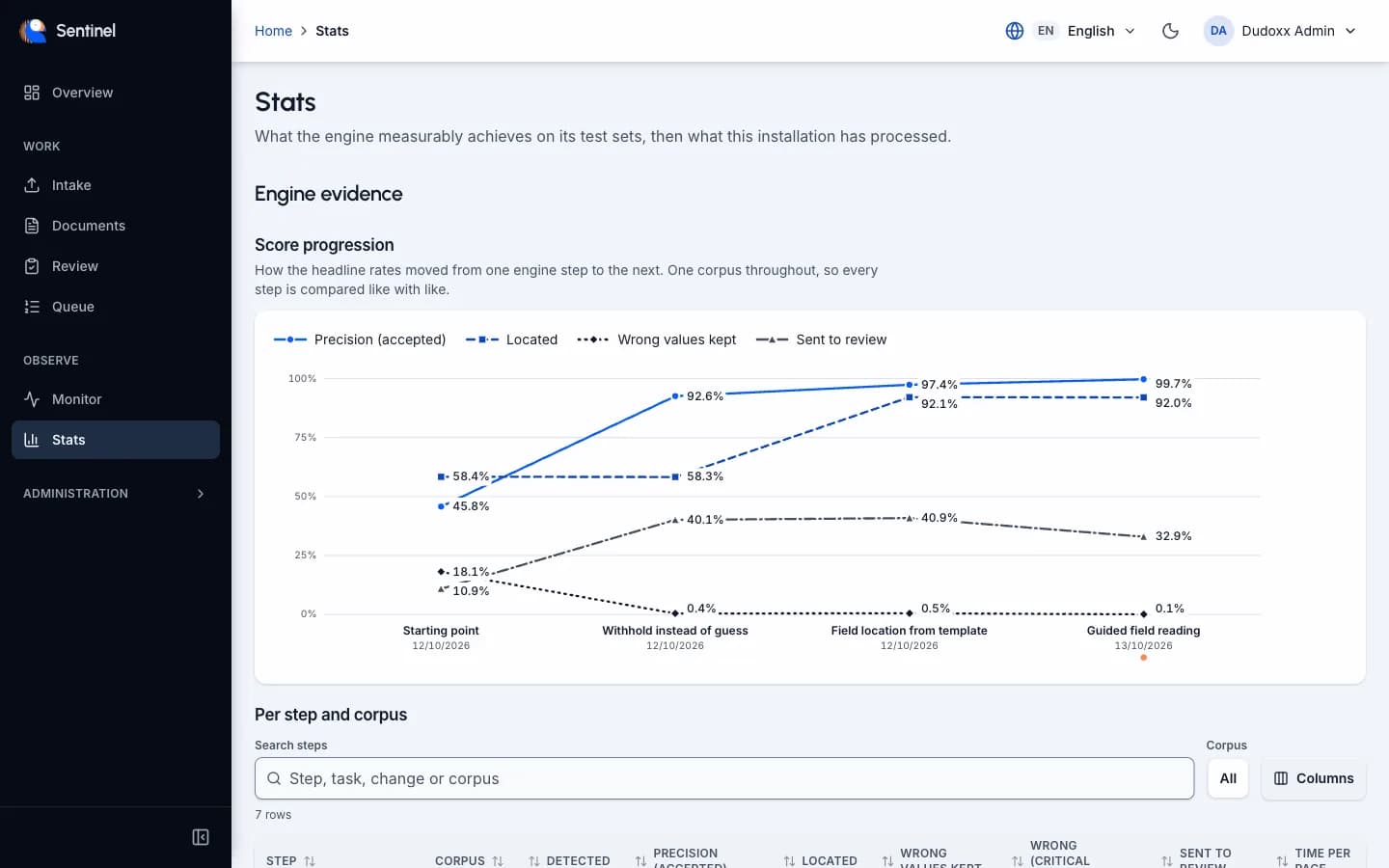
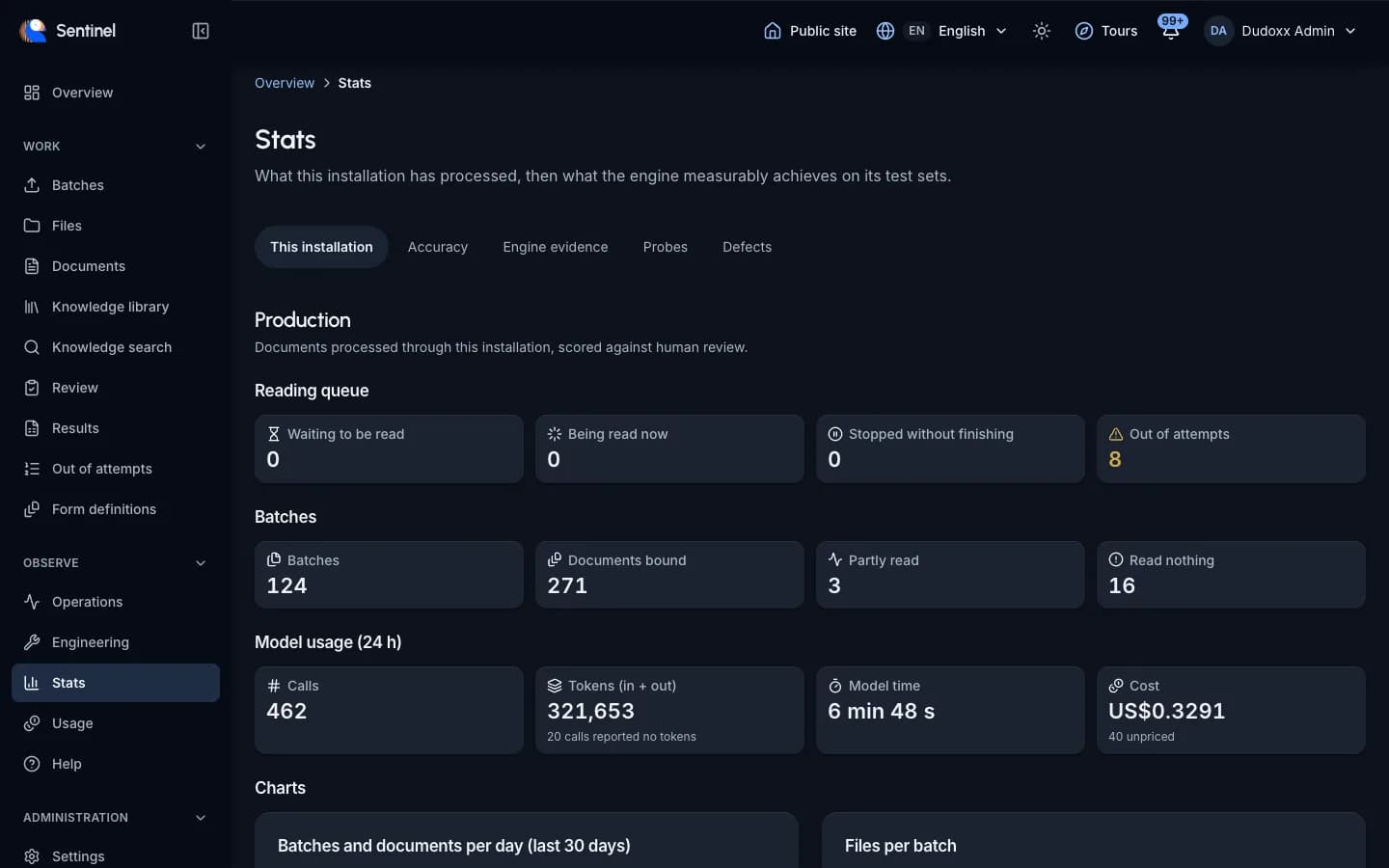
Follow every improvement, step by step
Each improvement is measured the same way, so you see what changed and by how much.
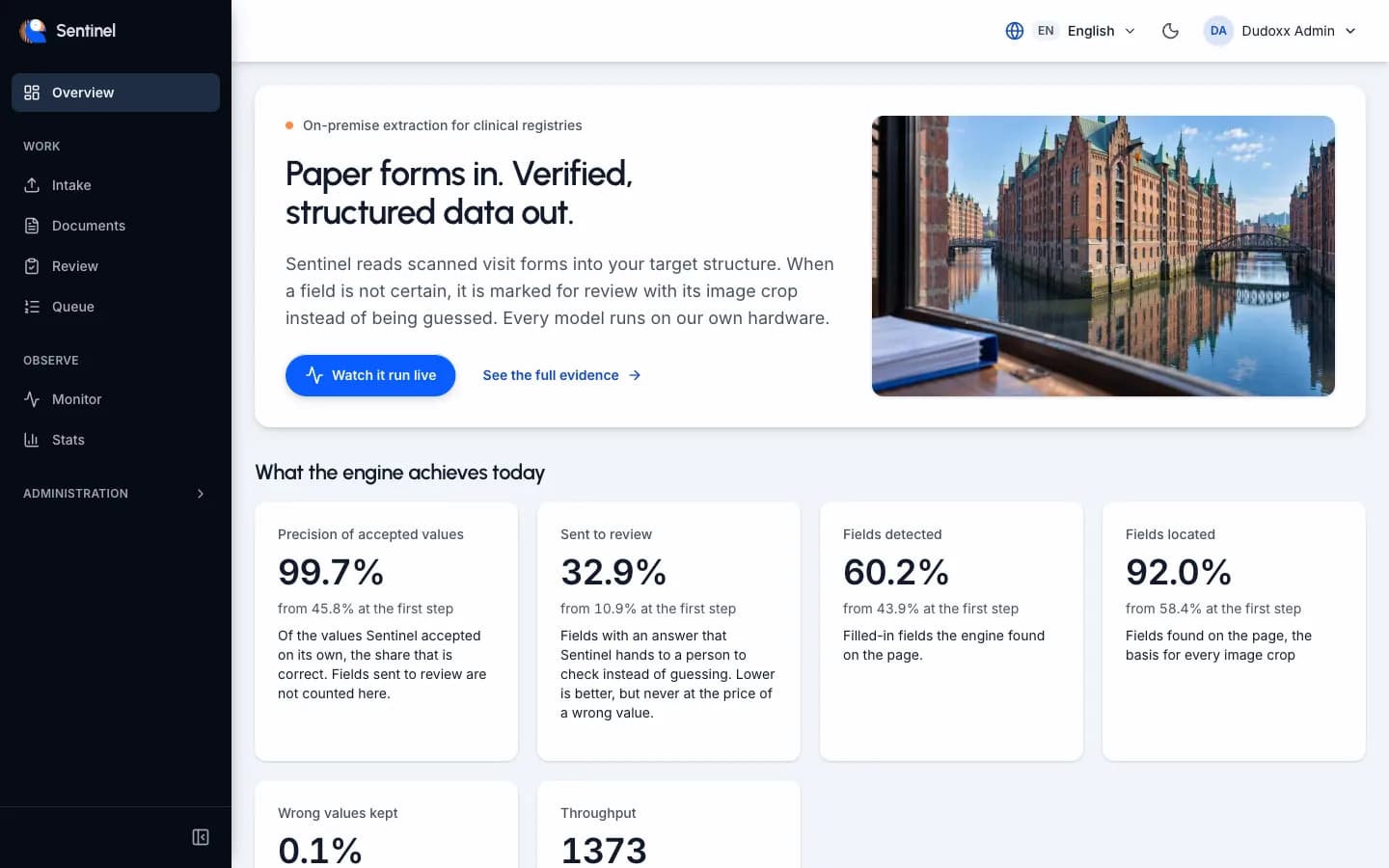
See the quality before you trust it
Every improvement is measured on the same 80 synthetic test pages: how many accepted answers are right, how often the image crop sits in the right place, and how many fields go to a person.
Reading routes
The right route for each form type
Sentinel has several ways to read a page. We choose one per form type, and each route is benchmarked before it goes live.
Standard route
The default for most forms: every field is found on the blank form and read with checks.
Alternative route
A different way of reading, kept for form types where it scores better on our test pages.
Tick-box grids
For forms with no blank template: tick-box grids are found on the page itself, so a new form can be handled without preparation.
Combined route, under evaluation
Routes that work on the same page and send a field to a person when they disagree. Selectable, not yet the default.
Evidence at scale
Measured, not claimed
2,856 pages scored in 69 benchmark runs across 12 engine steps, all on synthetic test pages.
Pages scored
2,856
Benchmark runs
69
Engine steps
12
Years of Dudoxx R&D
4
Dudoxx fine-tuned, trained and optimised LLM agentic pipeline
Built and tuned by Dudoxx for forms and registries.
Part of the Dudoxx AI HMS platform
Sentinel is the research and registry door of the platform.
On our servers in Germany, or on yours
You choose where your pages are processed.
Your data never trains a model
Your pages and results stay yours.
How to read this
What this run does and does not show
We state the limits next to the numbers, so you can judge them yourself.
Synthetic test forms
Every page in this run is a synthetic test form. No real patient pages were used.
No sealed holdout yet
The test pages were used while we improved the system. A sealed set of pages that nobody has seen is still to come.
Your own forms, in a pilot
Results on your forms are confirmed in a pilot on a sample of your own pages, before anything goes into daily use.
Doubt goes to a person
A wrong value is worse than a blank. Where Sentinel is not sure, it leaves the field for a person and shows the image crop to check.
See it with your own forms
Tell us about your forms and your volume. We will confirm the results on a sample of your pages.